Components
The components are the core of the underlying network of the energy system. All component can be assigned a user-label when created. The user has to provide information regarding connections between busses and in/out of the component. A component which has only inputs defined is referred to as a sink. A component with only outputs is referred to as a source. A component with both input and outputs is a converter. These three very basic type of components are provided by the classes Sink, Source and Converter. Furthermore, other Components such as storage components, offsetconverters (allowing variable part-load efficiency) or specialized CHP components are available.
Components are divided in two categories. Well-tested components (Solph components) and experimental components (Experimental components), listed below
Solph components
Experimental components
The experimental section was created to lower the entry barrier to bring new components into oemof-solph. Be aware that these components might not be properly documented or even sometimes do not even work as intended. Let us know if you have successfully used and tested these components. This is the first step to move them to the regular components section.
Sink
A sink is normally used to define the demand within an energy model but it can also be used to detect excesses.
The example shows the electricity demand of the electricity_bus defined above. The ‘my_demand_series’ should be sequence of normalised valueswhile the ‘nominal_capacity’ is the maximum demand the normalised sequence is multiplied with. Giving ‘my_demand_series’ as parameter ‘fix’ means that the demand cannot be changed by the solver.
solph.components.Sink(label='electricity_demand', inputs={electricity_bus: solph.flows.Flow(
    fix=my_demand_series, nominal_capacity=nominal_demand)})
In contrast to the demand sink the excess sink has normally less restrictions but is open to take the whole excess.
solph.components.Sink(label='electricity_excess', inputs={electricity_bus: solph.flows.Flow()})
Note
The Sink class is only a plug and provides no additional constraints or variables.
Source
A source can represent a pv-system, a wind power plant, an import of natural gas or a slack variable to avoid creating an in-feasible model.
While a wind power plant will have as feed-in depending on the weather conditions the natural_gas import might be restricted by maximum value (nominal_capacity) and an annual limit (full_load_time_max). As we do have to pay for imported gas we should set variable costs. Comparable to the demand series an fix is used to define a fixed the normalised output of a wind power plant. Alternatively, you might use max to allow for easy curtailment. The nominal_capacity sets the installed capacity.
solph.components.Source(
    label='import_natural_gas',
    outputs={my_energysystem.groups['natural_gas']: solph.flows.Flow(
        nominal_capacity=1000, full_load_time_max=1000000, variable_costs=50)})

solph.components.Source(label='wind', outputs={electricity_bus: solph.flows.Flow(
    fix=wind_power_feedin_series, nominal_capacity=1000000)})
Note
The Source class is only a plug and provides no additional constraints or variables.
Converter
An instance of the Converter class can represent a node with multiple input and output flows such as a power plant, a transport line or any kind of a transforming process as electrolysis, a cooling device or a heat pump. The efficiency has to be constant within one time step to get a linear transformation. You can define a different efficiency for every time step (e.g. the thermal powerplant efficiency according to the ambient temperature) but this series has to be predefined and cannot be changed within the optimisation.
A condensing power plant can be defined by a converter with one input (fuel) and one output (electricity).
b_gas = solph.buses.Bus(label='natural_gas')
b_el = solph.buses.Bus(label='electricity')

solph.components.Converter(
    label="pp_gas",
    inputs={bgas: solph.flows.Flow()},
    outputs={b_el: solph.flows.Flow(nominal_capacity=10e10)},
    conversion_factors={electricity_bus: 0.58})
A CHP power plant would be defined in the same manner but with two outputs:
b_gas = solph.buses.Bus(label='natural_gas')
b_el = solph.buses.Bus(label='electricity')
b_th = solph.buses.Bus(label='heat')

solph.components.Converter(
    label='pp_chp',
    inputs={b_gas: Flow()},
    outputs={b_el: Flow(nominal_capacity=30),
             b_th: Flow(nominal_capacity=40)},
    conversion_factors={b_el: 0.3, b_th: 0.4})
A CHP power plant with 70% coal and 30% natural gas can be defined with two inputs and two outputs:
b_gas = solph.buses.Bus(label='natural_gas')
b_coal = solph.buses.Bus(label='hard_coal')
b_el = solph.buses.Bus(label='electricity')
b_th = solph.buses.Bus(label='heat')

solph.components.Converter(
    label='pp_chp',
    inputs={b_gas: Flow(), b_coal: Flow()},
    outputs={b_el: Flow(nominal_capacity=30),
             b_th: Flow(nominal_capacity=40)},
    conversion_factors={b_el: 0.3, b_th: 0.4,
                        b_coal: 0.7, b_gas: 0.3})
A heat pump would be defined in the same manner. New buses are defined to make the code cleaner:
b_el = solph.buses.Bus(label='electricity')
b_th_low = solph.buses.Bus(label='low_temp_heat')
b_th_high = solph.buses.Bus(label='high_temp_heat')

# The cop (coefficient of performance) of the heat pump can be defined as
# a scalar or a sequence.
cop = 3

solph.components.Converter(
    label='heat_pump',
    inputs={b_el: Flow(), b_th_low: Flow()},
    outputs={b_th_high: Flow()},
    conversion_factors={b_el: 1/cop,
                        b_th_low: (cop-1)/cop})
If the low-temperature reservoir is nearly infinite (ambient air heat pump) the low temperature bus is not needed and, therefore, a Converter with one input is sufficient.
Note
See the Converter class for all parameters and the mathematical background.
GenericStorage
A component to model a storage with its basic characteristics. The
GenericStorage is designed for one input and one output.
The nominal_storage_capacity of the storage signifies the storage capacity.
You can either set it to the net capacity or to the gross capacity and limit it
using the minimum/maximum attribute. To limit the input and output flows, you can
define the nominal_capacity in the Flow objects. Furthermore, an efficiency
for loading, unloading and a loss rate can be defined.
solph.components.GenericStorage(
    label='storage',
    inputs={b_el: solph.flows.Flow(nominal_capacity=9, variable_costs=10)},
    outputs={b_el: solph.flows.Flow(nominal_capacity=25, variable_costs=10)},
    loss_rate=0.001, nominal_capacity=50,
    inflow_conversion_factor=0.98, outflow_conversion_factor=0.8)
For initialising the state of charge before the first time step (time step
zero) the parameter initial_storage_level (default value: None) can be
set by a numeric value as fraction of the storage capacity. Additionally the
parameter balanced (default value: True) sets the relation of the state
of charge of time step zero and the last time step. If balanced=True, the
state of charge in the last time step is equal to initial value in time step
zero. Use balanced=False with caution as energy might be added to or taken
from the energy system due to different states of charge in time step zero and
the last time step. Generally, with these two parameters four configurations
are possible, which might result in different solutions of the same
optimization model:
initial_storage_level=None,balanced=True(default setting): The state of charge in time step zero is a result of the optimization. The state of charge of the last time step is equal to time step zero. Thus, the storage is not violating the energy conservation by adding or taking energy from the system due to different states of charge at the beginning and at the end of the optimization period.initial_storage_level=0.5,balanced=True: The state of charge in time step zero is fixed to 0.5 (50 % charged). The state of charge in the last time step is also constrained by 0.5 due to the coupling parameterbalancedset toTrue.initial_storage_level=None,balanced=False: Both, the state of charge in time step zero and the last time step are a result of the optimization and not coupled.initial_storage_level=0.5,balanced=False: The state of charge in time step zero is constrained by a given value. The state of charge of the last time step is a result of the optimization.
The following code block shows an example of the storage parametrization for the second configuration:
solph.components.GenericStorage(
    label='storage',
    inputs={b_el: solph.flows.Flow(nominal_capacity=9, variable_costs=10)},
    outputs={b_el: solph.flows.Flow(nominal_capacity=25, variable_costs=10)},
    loss_rate=0.001, nominal_capacity=50,
    initial_storage_level=0.5, balanced=True,
    inflow_conversion_factor=0.98, outflow_conversion_factor=0.8)
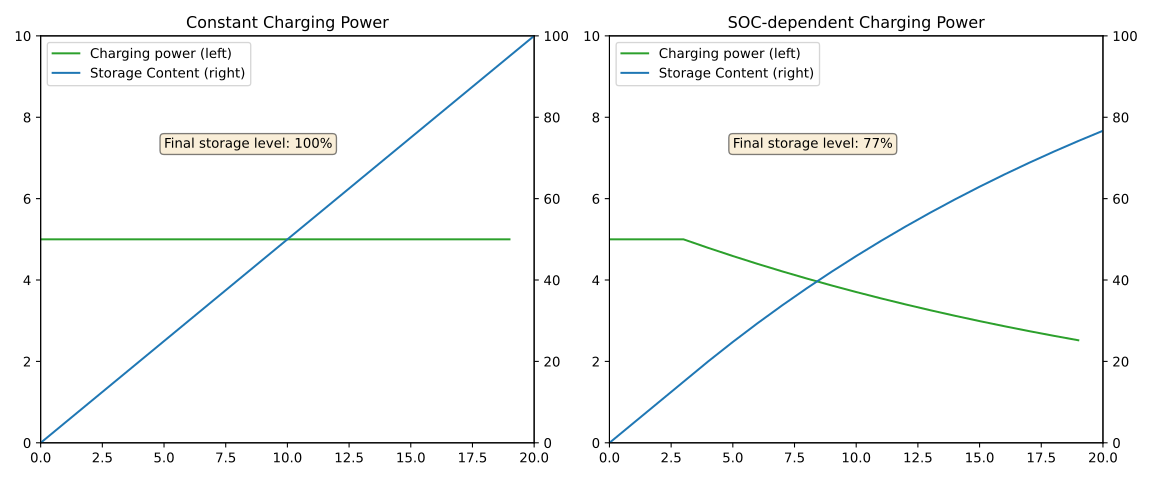
It is also possible to model a storage with a soc-dependent charging power.
solph.components.GenericStorage(
    label="SOC-dependent",
    inputs={bus: solph.Flow(10)},
    outputs={bus: solph.Flow(10)},
    nominal_capacity=100,
    constant_soc_until=0.2,
    fraction_saturation_charging=0.3,
If you want to view the temporal course of the state of charge of your storage
after the optimisation, you need to check the storage_content in the results:
from oemof import solph
results = model.solve()
results["storage_content"]["your_storage_label"]
The storage_content is the absolute value of the current stored energy.
For more information see the definition of the
GenericStorage class
or check the Examples.
Using an investment object with the GenericStorage component
Based on the GenericStorage object the GenericInvestmentStorageBlock adds two main investment possibilities.
Invest into the flow parameters e.g. a turbine or a pump
Invest into capacity of the storage e.g. a basin or a battery cell
Investment in this context refers to the value of the variable for the
nominal_capacity (installed capacity) in the investment mode.
As an addition to other flow-investments, the storage class implements the possibility to couple or decouple the flows with the capacity of the storage. Three parameters are responsible for connecting the flows and the capacity of the storage:
invest_relation_input_capacityfixes the input flow investment to the capacity investment. A ratio of 1 means that the storage can be filled within one time-period.invest_relation_output_capacityfixes the output flow investment to the capacity investment. A ratio of 1 means that the storage can be emptied within one period.invest_relation_input_outputfixes the input flow investment to the output flow investment. For values <1, the input will be smaller and for values >1 the input flow will be larger.
You should not set all 3 parameters at the same time, since it will lead to overdetermination.
The following example pictures a Pumped Hydroelectric Energy Storage (PHES). Both, flows and the storage itself, (representing: pump, turbine, basin) are free in their investment. You can set the parameters to None or delete them as None is the default value.
solph.components.GenericStorage(
    label='PHES',
    inputs={b_el: solph.flows.Flow(nominal_capacity=solph.Investment(ep_costs=500))},
    outputs={b_el: solph.flows.Flow(nominal_capacity=solph.Investment(ep_costs=500)},
    loss_rate=0.001,
    inflow_conversion_factor=0.98, outflow_conversion_factor=0.8),
    nominal_capacity=solph.Investment(ep_costs=40),
)
The following example describes a battery with flows coupled to the capacity of the storage. Note that the capacity of the flows depends on an investment but has no assigned costs.
solph.components.GenericStorage(
    label='battery',
    inputs={b_el: solph.flows.Flow(nominal_capacity=solph.Investment())},
    outputs={b_el: solph.flows.Flow(nominal_capacity=solph.Investment())},
    loss_rate=0.001,
    inflow_conversion_factor=0.98,
     outflow_conversion_factor=0.8,
    invest_relation_input_capacity = 1/6,
    invest_relation_output_capacity = 1/6,
    nominal_capacity=solph.Investment(ep_costs=400),
)
Note
See the GenericStorage class for all parameters and the mathematical background.
OffsetConverter
The OffsetConverter object makes it possible to create a Converter with efficiencies depending on the part load condition. For this it is necessary to define one flow as a nonconvex flow and to set a minimum load. The following example illustrates how to define an OffsetConverter for given information for an output, i.e. a combined heat and power plant. The plant generates up to 100 kW electric energy at an efficiency of 40 %. In minimal load the electric efficiency is at 30 %, and the minimum possible load is 50 % of the nominal load. At the same time, heat is produced with a constant efficiency. By using the OffsetConverter a linear relation of in- and output power with a power dependent efficiency is generated.
>>> from oemof import solph

>>> eta_el_min = 0.3                  # electrical efficiency at minimal operation point
>>> eta_el_max = 0.4                  # electrical efficiency at nominal operation point
>>> eta_th_min = 0.5                  # thermal efficiency at minimal operation point
>>> eta_th_max = 0.5                  # thermal efficiency at nominal operation point
>>> P_out_min = 20                    # absolute minimal output power
>>> P_out_max = 100                   # absolute nominal output power
As reference for our system we use the input and will mark that flow as nonconvex respectively. The efficiencies for electricity and heat output have therefore to be defined with respect to the input flow. The same is true for the minimal and maximal load. Therefore, we first calculate the minimum and maximum input of fuel and then derive the slope and offset for both outputs.
>>> P_in_max = P_out_max / eta_el_max
>>> P_in_min = P_out_min / eta_el_min
>>> P_in_max
250.0
>>> round(P_in_min, 2)
66.67
With that information, we can derive the normed minimal and maximal load of the nonconvex flow, and calculate the slope and the offset for both outputs. Note, that the offset for the heat output is 0, because the thermal heat output efficiency is constant.
>>> l_max = 1
>>> l_min = P_in_min / P_in_max
>>> slope_el, offset_el = solph.components.slope_offset_from_nonconvex_input(
...     l_max, l_min, eta_el_max, eta_el_min
... )
>>> slope_th, offset_th = solph.components.slope_offset_from_nonconvex_input(
...     l_max, l_min, eta_th_max, eta_th_min
... )
>>> round(slope_el, 3)
0.436
>>> round(offset_el, 3)
-0.036
>>> round(slope_th, 3)
0.5
>>> round(offset_th, 3)
0.0
Then we can create our component with the buses attached to it.
>>> bfuel = solph.Bus("fuel")
>>> bel = solph.Bus("electricity")
>>> bth = solph.Bus("heat")

# define OffsetConverter
>>> diesel_genset = solph.components.OffsetConverter(
...     label='boiler',
...     inputs={
...         bfuel: solph.flows.Flow(
...             nominal_capacity=P_out_max,
...             maximum=l_max,
...             minimum=l_min,
...             nonconvex=solph.NonConvex()
...         )
...     },
...     outputs={
...         bel: solph.flows.Flow(),
...         bth: solph.flows.Flow(),
...     },
...     conversion_factors={bel: slope_el, bth: slope_th},
...     normed_offsets={bel: offset_el, bth: offset_th},
... )
Note
One of the inputs and outputs has to be a NonConvex flow and this flow will serve as the reference for the conversion_factors and the normed_offsets. The NonConvex flow also holds
the nominal_capacity (can be Investment in case of investment optimization),
the minimum and
the maximum attributes.
The conversion_factors and normed_offsets are specified similar to the Converter API with dictionaries referencing the respective input and output buses. Note, that you cannot have the conversion_factors or normed_offsets point to the NonConvex flow.
The following figures show the power at the electrical and the thermal output and the resepctive ratios to the nonconvex flow (normalized). The efficiency becomes non-linear.


It also becomes clear, why the component has been named OffsetConverter. The linear equation of inflow to electrical outflow does not hit the origin, but is offset. By multiplying the offset \(y_\text{0,normed}\) with the binary status variable of the NonConvex flow, the origin (0, 0) becomes part of the solution space and the boiler is allowed to switch off.
\[\begin{split}& P(p, t) = P_\text{ref}(p, t) \cdot m(t) + P_\text{nom,ref}(p) \cdot Y_\text{ref}(t) \cdot y_\text{0,normed}(t) \\\end{split}\]The symbols used are defined as follows (with Variables (V) and Parameters (P)):
symbol
attribute
type
explanation
\(P(t)\)
flow[i,n,p,t] or flow[n,o,p,t]
V
Non-nonconvex flows at input or output
\(P_{in}(t)\)
flow[i,n,p,t] or flow[n,o,p,t]
V
nonconvex flow of converter
\(Y(t)\)
V
Binary status variable of nonconvex flow
\(P_{nom}(t)\)
V
Nominal value (max. capacity) of the nonconvex flow
\(m(t)\)
conversion_factors[i][n,t] or conversion_factors[o][n,t]
P
Linear coefficient 1 (slope) of a Non-nonconvex flows
\(y_\text{0,normed}(t)\)
normed_offsets[i][n,t] or normed_offsets[o][n,t]
P
Linear coefficient 0 (y-intersection)/P_{nom}(t) of Non-nonconvex flows
Note that \(P_{nom}(t) \cdot Y(t)\) is merged into one variable, called status_nominal[n, o, p, t].
The parameters \(y_\text{0,normed}\) and \(m\) can be given by scalars or by series in order to define a different efficiency equation for every timestep. It is also possible to define multiple outputs.
Note
See the OffsetConverter class for all parameters and the mathematical background.
ExtractionTurbineCHP
The ExtractionTurbineCHP
inherits from the Converter class. Like the name indicates,
the application example for the component is a flexible combined heat and power
(chp) plant. Of course, an instance of this class can represent also another
component with one input and two output flows and a flexible ratio between
these flows, with the following constraints:
\[\begin{split}& (1)\dot H_{Fuel}(t) = \frac{P_{el}(t) + \dot Q_{th}(t) \cdot \beta(t)} {\eta_{el,woExtr}(t)} \\ & (2)P_{el}(t) \geq \dot Q_{th}(t) \cdot C_b\end{split}\]where:
\[\beta(t) = \frac{\eta_{el,woExtr}(t) - \eta_{el,maxExtr}(t)}{\eta_{th,maxExtr}(t)}\]and:
\[C_b = \frac{\eta_{el,maxExtr}(t)}{\eta_{th,maxExtr}(t)}\]The first equation is the result of the relation between the input flow and the two output flows, the second equation stems from how the two output flows relate to each other, and the symbols used are defined as follows (with Variables (V) and Parameters (P)):
symbol
attribute
type
explanation
\(\dot H_{Fuel}\)
flow[i, n, t]
V
fuel input flow
\(P_{el}\)
flow[n, main_output, t]
V
electric power
\(\dot Q_{th}\)
flow[n, tapped_output, t]
V
thermal output
\(\beta\)
main_flow_loss_index[n, t]
P
power loss index
\(\eta_{el,woExtr}\)
conversion_factor_full_condensation[n, t]
P
- electric efficiency
without heat extraction
\(\eta_{el,maxExtr}\)
conversion_factors[main_output][n, t]
P
- electric efficiency
with max heat extraction
\(\eta_{th,maxExtr}\)
conversion_factors[tapped_output][n, t]
P
- thermal efficiency with
maximal heat extraction
These constraints are applied in addition to those of a standard
Converter. The constraints limit the range of
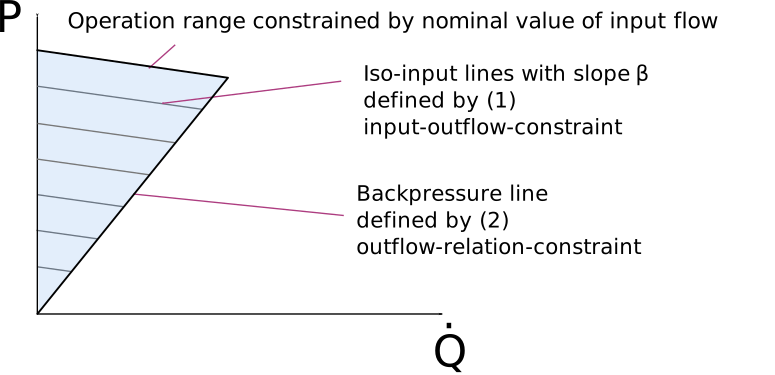
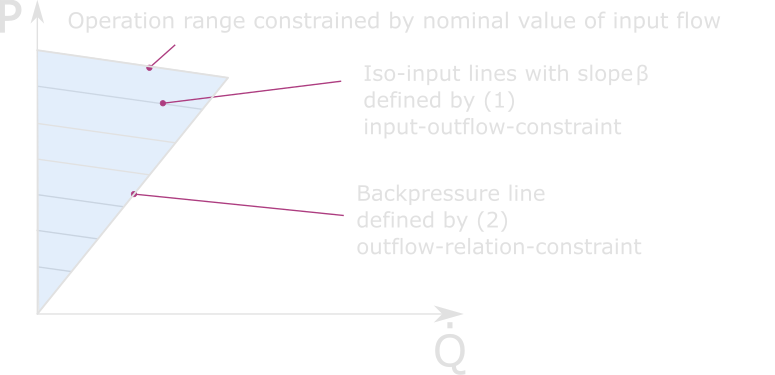
the possible operation points, like the following picture shows. For a certain
flow of fuel, there is a line of operation points, whose slope is defined by
the power loss factor \(\beta\) (in some contexts also referred to as
\(C_v\)). The second constraint limits the decrease of electrical power and
incorporates the backpressure coefficient \(C_b\).
For now, ExtractionTurbineCHP instances must
have one input and two output flows. The class allows the definition
of a different efficiency for every time step that can be passed as a series
of parameters that are fixed before the optimisation. In contrast to the
Converter, a main flow and a tapped flow is
defined. For the main flow you can define a separate conversion factor that
applies when the second flow is zero (`conversion_factor_full_condensation`).
solph.components._extractionTurbineCHP(
    label='variable_chp_gas',
    inputs={b_gas: solph.flows.Flow(nominal_capacity=10e10)},
    outputs={b_el: solph.flows.Flow(), b_th: solph.flows.Flow()},
    conversion_factors={b_el: 0.3, b_th: 0.5},
    conversion_factor_full_condensation={b_el: 0.5})
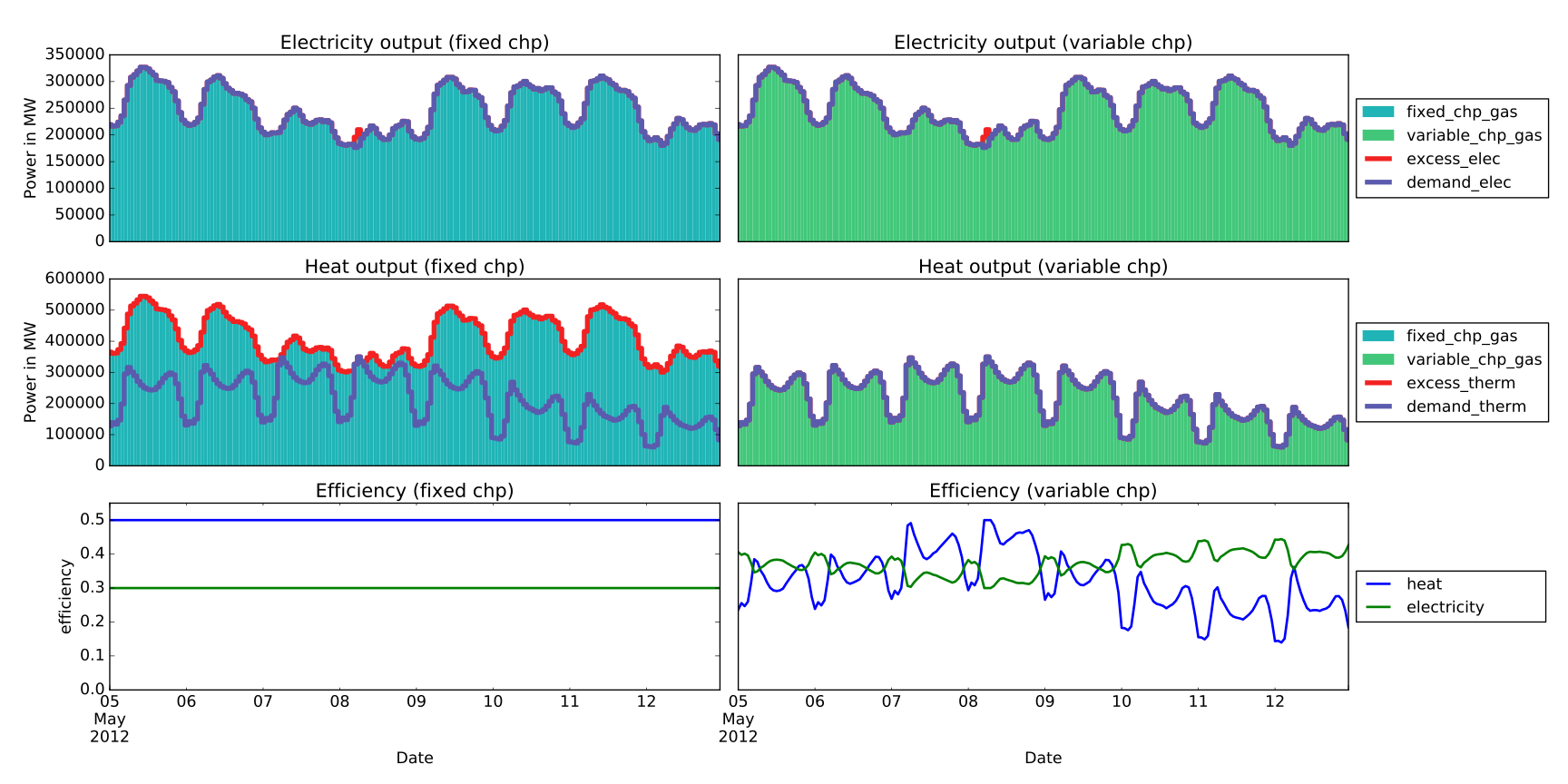
The key of the parameter ‘conversion_factor_full_condensation’ defines which of the two flows is the main flow. In the example above, the flow to the Bus ‘b_el’ is the main flow and the flow to the Bus ‘b_th’ is the tapped flow. The following plot shows how the variable chp (right) schedules it’s electrical and thermal power production in contrast to a fixed chp (left). The plot is the output of an example in the example directory.
Note
See the ExtractionTurbineCHP class for all parameters and the mathematical background.
GenericCHP
With the GenericCHP class it is possible to model different types of CHP plants (combined cycle extraction turbines, back pressure turbines and motoric CHP), which use different ranges of operation, as shown in the figure below.
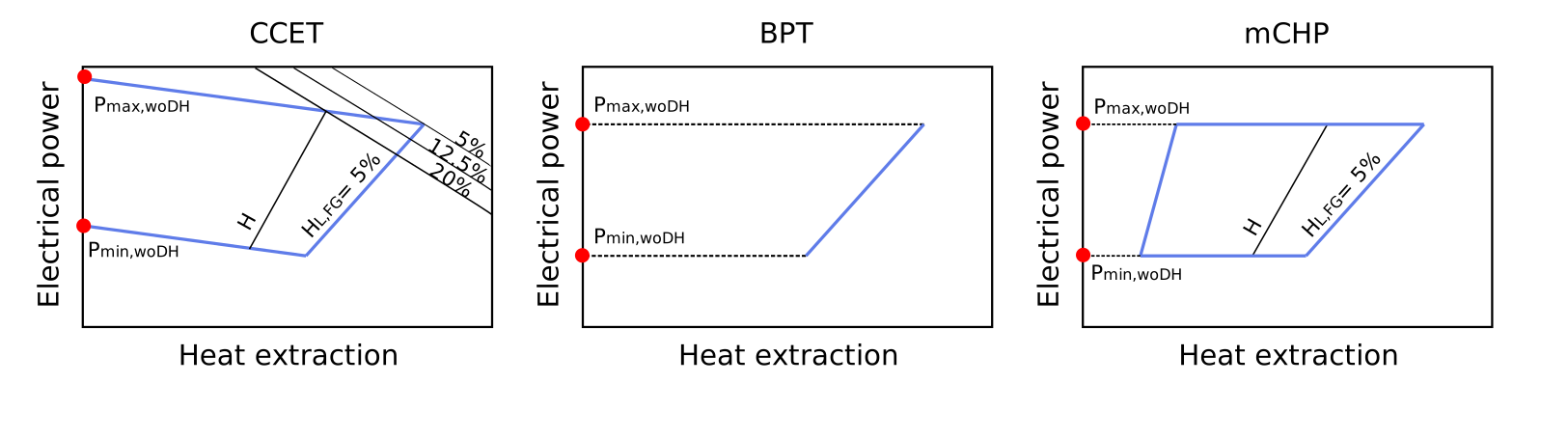

Combined cycle extraction turbines: The minimal and maximal electric power without district heating (red dots in the figure) define maximum load and minimum load of the plant. Beta defines electrical power loss through heat extraction. The minimal thermal condenser load to cooling water and the share of flue gas losses at maximal heat extraction determine the right boundary of the operation range.
solph.components.GenericCHP(
    label='combined_cycle_extraction_turbine',
    fuel_input={bgas: solph.flows.Flow(
        H_L_FG_share_max=[0.19 for p in range(0, periods)])},
    electrical_output={bel: solph.flows.Flow(
        P_max_woDH=[200 for p in range(0, periods)],
        P_min_woDH=[80 for p in range(0, periods)],
        Eta_el_max_woDH=[0.53 for p in range(0, periods)],
        Eta_el_min_woDH=[0.43 for p in range(0, periods)])},
    heat_output={bth: solph.flows.Flow(
        Q_CW_min=[30 for p in range(0, periods)])},
    Beta=[0.19 for p in range(0, periods)],
    back_pressure=False)
For modeling a back pressure CHP, the attribute back_pressure has to be set to True. The ratio of power and heat production in a back pressure plant is fixed, therefore the operation range is just a line (see figure). Again, the P_min_woDH and P_max_woDH, the efficiencies at these points and the share of flue gas losses at maximal heat extraction have to be specified. In this case “without district heating” is not to be taken literally since an operation without heat production is not possible. It is advised to set Beta to zero, so the minimal and maximal electric power without district heating are the same as in the operation point (see figure). The minimal thermal condenser load to cooling water has to be zero, because there is no condenser besides the district heating unit.
solph.components.GenericCHP(
    label='back_pressure_turbine',
    fuel_input={bgas: solph.flows.Flow(
        H_L_FG_share_max=[0.19 for p in range(0, periods)])},
    electrical_output={bel: solph.flows.Flow(
        P_max_woDH=[200 for p in range(0, periods)],
        P_min_woDH=[80 for p in range(0, periods)],
        Eta_el_max_woDH=[0.53 for p in range(0, periods)],
        Eta_el_min_woDH=[0.43 for p in range(0, periods)])},
    heat_output={bth: solph.flows.Flow(
        Q_CW_min=[0 for p in range(0, periods)])},
    Beta=[0 for p in range(0, periods)],
    back_pressure=True)
A motoric chp has no condenser, so Q_CW_min is zero. Electrical power does not depend on the amount of heat used so Beta is zero. The minimal and maximal electric power (without district heating) and the efficiencies at these points are needed, whereas the use of electrical power without using thermal energy is not possible. With Beta=0 there is no difference between these points and the electrical output in the operation range. As a consequence of the functionality of a motoric CHP, share of flue gas losses at maximal heat extraction but also at minimal heat extraction have to be specified.
solph.components.GenericCHP(
    label='motoric_chp',
    fuel_input={bgas: solph.flows.Flow(
        H_L_FG_share_max=[0.18 for p in range(0, periods)],
        H_L_FG_share_min=[0.41 for p in range(0, periods)])},
    electrical_output={bel: solph.flows.Flow(
        P_max_woDH=[200 for p in range(0, periods)],
        P_min_woDH=[100 for p in range(0, periods)],
        Eta_el_max_woDH=[0.44 for p in range(0, periods)],
        Eta_el_min_woDH=[0.40 for p in range(0, periods)])},
    heat_output={bth: solph.flows.Flow(
        Q_CW_min=[0 for p in range(0, periods)])},
    Beta=[0 for p in range(0, periods)],
    back_pressure=False)
Modeling different types of plants means telling the component to use different constraints. Constraint 1 to 9 are active in all three cases. Constraint 10 depends on the attribute back_pressure. If true, the constraint is an equality, if not it is a less or equal. Constraint 11 is only needed for modeling motoric CHP which is done by setting the attribute H_L_FG_share_min.
\[\begin{split}& (1)\qquad \dot{H}_F(t) = fuel\ input \\ & (2)\qquad \dot{Q}(t) = heat\ output \\ & (3)\qquad P_{el}(t) = power\ output\\ & (4)\qquad \dot{H}_F(t) = \alpha_0(t) \cdot Y(t) + \alpha_1(t) \cdot P_{el,woDH}(t)\\ & (5)\qquad \dot{H}_F(t) = \alpha_0(t) \cdot Y(t) + \alpha_1(t) \cdot ( P_{el}(t) + \beta \cdot \dot{Q}(t) )\\ & (6)\qquad \dot{H}_F(t) \leq Y(t) \cdot \frac{P_{el, max, woDH}(t)}{\eta_{el,max,woDH}(t)}\\ & (7)\qquad \dot{H}_F(t) \geq Y(t) \cdot \frac{P_{el, min, woDH}(t)}{\eta_{el,min,woDH}(t)}\\ & (8)\qquad \dot{H}_{L,FG,max}(t) = \dot{H}_F(t) \cdot \dot{H}_{L,FG,sharemax}(t)\\ & (9)\qquad \dot{H}_{L,FG,min}(t) = \dot{H}_F(t) \cdot \dot{H}_{L,FG,sharemin}(t)\\ & (10)\qquad P_{el}(t) + \dot{Q}(t) + \dot{H}_{L,FG,max}(t) + \dot{Q}_{CW, min}(t) \cdot Y(t) = / \leq \dot{H}_F(t)\\\end{split}\]where \(= / \leq\) depends on the CHP being back pressure or not.
The coefficients \(\alpha_0\) and \(\alpha_1\) can be determined given the efficiencies maximal/minimal load:
\[\begin{split}& \eta_{el,max,woDH}(t) = \frac{P_{el,max,woDH}(t)}{\alpha_0(t) \cdot Y(t) + \alpha_1(t) \cdot P_{el,max,woDH}(t)}\\ & \eta_{el,min,woDH}(t) = \frac{P_{el,min,woDH}(t)}{\alpha_0(t) \cdot Y(t) + \alpha_1(t) \cdot P_{el,min,woDH}(t)}\\\end{split}\]
If \(\dot{H}_{L,FG,min}\) is given, e.g. for a motoric CHP:
\[\begin{split}& (11)\qquad P_{el}(t) + \dot{Q}(t) + \dot{H}_{L,FG,min}(t) + \dot{Q}_{CW, min}(t) \cdot Y(t) \geq \dot{H}_F(t)\\[10pt]\end{split}\]The symbols used are defined as follows (with Variables (V) and Parameters (P)):
math. symbol
attribute
type
explanation
\(\dot{H}_{F}\)
H_F[n,t]
V
input of enthalpy through fuel input
\(P_{el}\)
P[n,t]
V
provided electric power
\(P_{el,woDH}\)
P_woDH[n,t]
V
electric power without district heating
\(P_{el,min,woDH}\)
P_min_woDH[n,t]
P
min. electric power without district heating
\(P_{el,max,woDH}\)
P_max_woDH[n,t]
P
max. electric power without district heating
\(\dot{Q}\)
Q[n,t]
V
provided heat
\(\dot{Q}_{CW, min}\)
Q_CW_min[n,t]
P
minimal therm. condenser load to cooling water
\(\dot{H}_{L,FG,min}\)
H_L_FG_min[n,t]
V
flue gas enthalpy loss at min heat extraction
\(\dot{H}_{L,FG,max}\)
H_L_FG_max[n,t]
V
flue gas enthalpy loss at max heat extraction
\(\dot{H}_{L,FG,sharemin}\)
H_L_FG_share_min[n,t]
P
share of flue gas loss at min heat extraction
\(\dot{H}_{L,FG,sharemax}\)
H_L_FG_share_max[n,t]
P
share of flue gas loss at max heat extraction
\(Y\)
Y[n,t]
V
status variable on/off
\(\alpha_0\)
n.alphas[0][n,t]
P
coefficient describing efficiency
\(\alpha_1\)
n.alphas[1][n,t]
P
coefficient describing efficiency
\(\beta\)
beta[n,t]
P
power loss index
\(\eta_{el,min,woDH}\)
Eta_el_min_woDH[n,t]
P
el. eff. at min. fuel flow w/o distr. heating
\(\eta_{el,max,woDH}\)
Eta_el_max_woDH[n,t]
P
el. eff. at max. fuel flow w/o distr. heating
Note
See the GenericCHP class for all parameters and the mathematical background.
Link (experimental)
The Link allows to model connections between two busses, e.g. modeling the transshipment of electric energy between two regions.
Note
See the Link class for all parameters and the mathematical background.
GenericCAES (experimental)
Compressed Air Energy Storage (CAES). The following constraints describe the CAES:
\[\begin{split}& (1) \qquad P_{cmp}(t) = electrical\_input (t) \quad \forall t \in T \\ & (2) \qquad P_{cmp\_max}(t) = m_{cmp\_max} \cdot CAS_{fil}(t-1) + b_{cmp\_max} \quad \forall t \in\left[1, t_{max}\right] \\ & (3) \qquad P_{cmp\_max}(t) = b_{cmp\_max} \quad \forall t \notin\left[1, t_{max}\right] \\ & (4) \qquad P_{cmp}(t) \leq P_{cmp\_max}(t) \quad \forall t \in T \\ & (5) \qquad P_{cmp}(t) \geq P_{cmp\_min} \cdot ST_{cmp}(t) \quad \forall t \in T \\ & (6) \qquad P_{cmp}(t) = m_{cmp\_max} \cdot CAS_{fil\_max} + b_{cmp\_max} \cdot ST_{cmp}(t) \quad \forall t \in T \\ & (7) \qquad \dot{Q}_{cmp}(t) = m_{cmp\_q} \cdot P_{cmp}(t) + b_{cmp\_q} \cdot ST_{cmp}(t) \quad \forall t \in T \\ & (8) \qquad \dot{Q}_{cmp}(t) = \dot{Q}_{cmp_out}(t) + \dot{Q}_{tes\_in}(t) \quad \forall t \in T \\ & (9) \qquad r_{cmp\_tes} \cdot\dot{Q}_{cmp\_out}(t) = \left(1-r_{cmp\_tes}\right) \dot{Q}_{tes\_in}(t) \quad \forall t \in T \\ & (10) \quad\; P_{exp}(t) = electrical\_output (t) \quad \forall t \in T \\ & (11) \quad\; P_{exp\_max}(t) = m_{exp\_max} CAS_{fil}(t-1) + b_{exp\_max} \quad \forall t \in\left[1, t_{\max }\right] \\ & (12) \quad\; P_{exp\_max}(t) = b_{exp\_max} \quad \forall t \notin\left[1, t_{\max }\right] \\ & (13) \quad\; P_{exp}(t) \leq P_{exp\_max}(t) \quad \forall t \in T \\ & (14) \quad\; P_{exp}(t) \geq P_{exp\_min}(t) \cdot ST_{exp}(t) \quad \forall t \in T \\ & (15) \quad\; P_{exp}(t) \leq m_{exp\_max} \cdot CAS_{fil\_max} + b_{exp\_max} \cdot ST_{exp}(t) \quad \forall t \in T \\ & (16) \quad\; \dot{Q}_{exp}(t) = m_{exp\_q} \cdot P_{exp}(t) + b_{cxp\_q} \cdot ST_{cxp}(t) \quad \forall t \in T \\ & (17) \quad\; \dot{Q}_{exp\_in}(t) = fuel\_input(t) \quad \forall t \in T \\ & (18) \quad\; \dot{Q}_{exp}(t) = \dot{Q}_{exp\_in}(t) + \dot{Q}_{tes\_out}(t)+\dot{Q}_{cxp\_add}(t) \quad \forall t \in T \\ & (19) \quad\; r_{exp\_tes} \cdot \dot{Q}_{exp\_in}(t) = (1 - r_{exp\_tes})(\dot{Q}_{tes\_out}(t) + \dot{Q}_{exp\_add}(t)) \quad \forall t \in T \\ & (20) \quad\; \dot{E}_{cas\_in}(t) = m_{cas\_in}\cdot P_{cmp}(t) + b_{cas\_in}\cdot ST_{cmp}(t) \quad \forall t \in T \\ & (21) \quad\; \dot{E}_{cas\_out}(t) = m_{cas\_out}\cdot P_{cmp}(t) + b_{cas\_out}\cdot ST_{cmp}(t) \quad \forall t \in T \\ & (22) \quad\; \eta_{cas\_tmp} \cdot CAS_{fil}(t) = CAS_{fil}(t-1) + \tau\left(\dot{E}_{cas\_in}(t) - \dot{E}_{cas\_out}(t)\right) \quad \forall t \in\left[1, t_{max}\right] \\ & (23) \quad\; \eta_{cas\_tmp} \cdot CAS_{fil}(t) = \tau\left(\dot{E}_{cas\_in}(t) - \dot{E}_{cas\_out}(t)\right) \quad \forall t \notin\left[1, t_{max}\right] \\ & (24) \quad\; CAS_{fil}(t) \leq CAS_{fil\_max} \quad \forall t \in T \\ & (25) \quad\; TES_{fil}(t) = TES_{fil}(t-1) + \tau\left(\dot{Q}_{tes\_in}(t) - \dot{Q}_{tes\_out}(t)\right) \quad \forall t \in\left[1, t_{max}\right] \\ & (26) \quad\; TES_{fil}(t) = \tau\left(\dot{Q}_{tes\_in}(t) - \dot{Q}_{tes\_out}(t)\right) \quad \forall t \notin\left[1, t_{max}\right] \\ & (27) \quad\; TES_{fil}(t) \leq TES_{fil\_max} \quad \forall t \in T \\ &\end{split}\]Table: Symbols and attribute names of variables and parameters
Table 10 Variables (V) and Parameters (P)¶ symbol
attribute
type
explanation
\(ST_{cmp}\)
cmp_st[n,t]
V
Status of compression
\({P}_{cmp}\)
cmp_p[n,t]
V
Compression power
\({P}_{cmp\_max}\)
cmp_p_max[n,t]
V
Max. compression power
\(\dot{Q}_{cmp}\)
cmp_q_out_sum[n,t]
V
Summed heat flow in compression
\(\dot{Q}_{cmp\_out}\)
cmp_q_waste[n,t]
V
Waste heat flow from compression
\(ST_{exp}(t)\)
exp_st[n,t]
V
Status of expansion (binary)
\(P_{exp}(t)\)
exp_p[n,t]
V
Expansion power
\(P_{exp\_max}(t)\)
exp_p_max[n,t]
V
Max. expansion power
\(\dot{Q}_{exp}(t)\)
exp_q_in_sum[n,t]
V
Summed heat flow in expansion
\(\dot{Q}_{exp\_in}(t)\)
exp_q_fuel_in[n,t]
V
Heat (external) flow into expansion
\(\dot{Q}_{exp\_add}(t)\)
exp_q_add_in[n,t]
V
Additional heat flow into expansion
\(CAV_{fil}(t)\)
cav_level[n,t]
V
Filling level if CAE
\(\dot{E}_{cas\_in}(t)\)
cav_e_in[n,t]
V
Exergy flow into CAS
\(\dot{E}_{cas\_out}(t)\)
cav_e_out[n,t]
V
Exergy flow from CAS
\(TES_{fil}(t)\)
tes_level[n,t]
V
Filling level of Thermal Energy Storage (TES)
\(\dot{Q}_{tes\_in}(t)\)
tes_e_in[n,t]
V
Heat flow into TES
\(\dot{Q}_{tes\_out}(t)\)
tes_e_out[n,t]
V
Heat flow from TES
\(b_{cmp\_max}\)
cmp_p_max_b[n,t]
P
Specific y-intersection
\(b_{cmp\_q}\)
cmp_q_out_b[n,t]
P
Specific y-intersection
\(b_{exp\_max}\)
exp_p_max_b[n,t]
P
Specific y-intersection
\(b_{exp\_q}\)
exp_q_in_b[n,t]
P
Specific y-intersection
\(b_{cas\_in}\)
cav_e_in_b[n,t]
P
Specific y-intersection
\(b_{cas\_out}\)
cav_e_out_b[n,t]
P
Specific y-intersection
\(m_{cmp\_max}\)
cmp_p_max_m[n,t]
P
Specific slope
\(m_{cmp\_q}\)
cmp_q_out_m[n,t]
P
Specific slope
\(m_{exp\_max}\)
exp_p_max_m[n,t]
P
Specific slope
\(m_{exp\_q}\)
exp_q_in_m[n,t]
P
Specific slope
\(m_{cas\_in}\)
cav_e_in_m[n,t]
P
Specific slope
\(m_{cas\_out}\)
cav_e_out_m[n,t]
P
Specific slope
\(P_{cmp\_min}\)
cmp_p_min[n,t]
P
Min. compression power
\(r_{cmp\_tes}\)
cmp_q_tes_share[n,t]
P
Ratio between waste heat flow and heat flow into TES
\(r_{exp\_tes}\)
exp_q_tes_share[n,t]
P
\(\tau\)
m.timeincrement[n,t]
P
Time interval length
\(TES_{fil\_max}\)
tes_level_max[n,t]
P
Max. filling level of TES
\(CAS_{fil\_max}\)
cav_level_max[n,t]
P
Max. filling level of TES
\(\tau\)
cav_eta_tmp[n,t]
P
\(electrical\_input\)
flow[list(n.electrical_input.keys())[0], p, n, t]
P
Electr. power input into compression
\(electrical\_output\)
flow[n, list(n.electrical_output.keys())[0], p, t]
P
Electr. power output of expansion
\(fuel\_input\)
flow[list(n.fuel_input.keys())[0], n, p, t]
P
Heat input (external) into Expansion
Note
See the GenericCAES class for all parameters and the mathematical background.
SinkDSM (experimental)
SinkDSM can used to represent flexibility in a demand time series.
It can represent both, load shifting or load shedding.
For load shifting, elasticity of the demand is described by upper (~oemof.solph.custom.sink_dsm.SinkDSM.capacity_up) and lower (~oemof.solph.custom.SinkDSM.capacity_down) bounds where within the demand is allowed to vary.
Upwards shifted demand is then balanced with downwards shifted demand.
For load shedding, shedding capability is described by ~oemof.solph.custom.SinkDSM.capacity_down.
It both, load shifting and load shedding are allowed, ~oemof.solph.custom.SinkDSM.capacity_down limits the sum of both downshift categories.
SinkDSM provides three approaches how the Demand-Side Management (DSM) flexibility is represented in constraints
It can be used for both, dispatch and investments modeling.
“DLR”: Implementation of the DSM modeling approach from by Gils (2015): Balancing of Intermittent Renewable Power Generation by Demand Response and Thermal Energy Storage, Stuttgart,, Details:
SinkDSMDLRBlockandSinkDSMDLRInvestmentBlock“DIW”: Implementation of the DSM modeling approach by Zerrahn & Schill (2015): On the representation of demand-side management in power system models, in: Energy (84), pp. 840-845, 10.1016/j.energy.2015.03.037. Details:
SinkDSMDIWBlockandSinkDSMDIWInvestmentBlock“oemof”: Is a fairly simple approach. Within a defined windows of time steps, demand can be shifted within the defined bounds of elasticity. The window sequentially moves forwards. Details:
SinkDSMOemofBlockandSinkDSMOemofInvestmentBlock
Cost can be associated to either demand up shifts or demand down shifts or both.
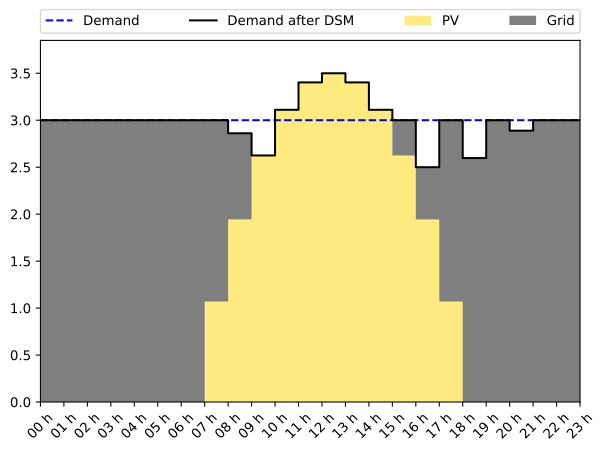
This small example of PV, grid and SinkDSM shows how to use the component
# Create some data
pv_day = [(-(1 / 6 * x ** 2) + 6) / 6 for x in range(-6, 7)]
pv_ts = [0] * 6 + pv_day + [0] * 6
data_dict = {"demand_el": [3] * len(pv_ts),
             "pv": pv_ts,
             "Cap_up": [0.5] * len(pv_ts),
             "Cap_do": [0.5] * len(pv_ts)}
data = pd.DataFrame.from_dict(data_dict)

# Do timestamp stuff
datetimeindex = pd.date_range(start='1/1/2013', periods=len(data.index), freq='h')
data['timestamp'] = datetimeindex
data.set_index('timestamp', inplace=True)

# Create Energy System
es = solph.EnergySystem(timeindex=datetimeindex)

# Create bus representing electricity grid
b_elec = solph.buses.Bus(label='Electricity bus')
es.add(b_elec)

# Create a back supply
grid = solph.components.Source(label='Grid',
                    outputs={
                        b_elec: solph.flows.Flow(
                            nominal_capacity=10000,
                            variable_costs=50)}
                    )
es.add(grid)

# PV supply from time series
s_wind = solph.components.Source(label='wind',
                      outputs={
                          b_elec: solph.flows.Flow(
                              fix=data['pv'],
                              nominal_capacity=3.5)}
                      )
es.add(s_wind)

# Create DSM Sink
demand_dsm = solph.custom.SinkDSM(label="DSM",
                                  inputs={b_elec: solph.flows.Flow()},
                                  demand=data['demand_el'],
                                  capacity_up=data["Cap_up"],
                                  capacity_down=data["Cap_do"],
                                  delay_time=6,
                                  max_demand=1,
                                  max_capacity_up=1,
                                  max_capacity_down=1,
                                  approach="DIW",
                                  cost_dsm_down=5)
es.add(demand_dsm)
Yielding the following results
Note
Keyword argument method from v0.4.1 has been renamed to approach in v0.4.2 and methods have been renamed.
The parameters demand, capacity_up and capacity_down have been normalized to allow investments modeling. To retreive the original dispatch behaviour from v0.4.1, set max_demand=1, max_capacity_up=1, max_capacity_down=1.
This component is a candidate component. It’s implemented as a custom component for users that like to use and test the component at early stage. Please report issues to improve the component.
See the
SinkDSMclass for all parameters and the mathematical background.